

What Role Does Long-term Care Services Play In The U.s. Healthcare Delivery System?
As a healthcare business organisation, you probably know that keeping up with digital transformation in healthcare can feel overwhelming.
Deciding which emerging technologies are worth investing in and getting your team on board with alter is often the hardest role.
Look, adapting to the digital era requires a shift towards a flexible and risk-taking mindset.
It means letting get of outdated business processes and trusting that disruption will yield large results. Earlier nosotros dive deeper into this topic, a quick recap.
Digital transformation in healthcare is the positive impact of engineering in healthcare.
Here'due south why: Telemedicine, artificial intelligence (AI)-enabled medical devices, and blockchain electronic health records are just a few concrete examples of digital transformation in healthcare which are completely reshaping how we collaborate with health professionals, how our data is shared amidst providers and how decisions are made about our handling plans and health outcomes.
Innovation is the name of the game here, with the master goal of streamlining physicians' piece of work, optimizing systems, improving patient outcomes, reducing man error, and lowering costs through astonishing spider web and mobile experiences.
Unfortunately, the healthcare and pharmaceutical industries have lagged backside when information technology comes to implementing digital strategies. Yes, yous read that right!
In fact, in a recent survey , only vii percent of healthcare and pharmaceutical companies said they had gone digital, compared to fifteen percent of companies in other industries.
In fact, in a recent survey, only vii pct of healthcare and pharmaceutical companies said they had gone digital, compared to xv pct of companies in other industries. Click To Tweet
Despite that, the U.S. healthcare market is enormous; with the national health spending projected to reach $5.7 trillion by 2026 . There'south all the same fourth dimension for you lot to get well-versed in digital technology and use it to bring in more business.Just in order to transform your standard do into a thriving, digital car in 2022, you offset need a comprehensive picture of the mod healthcare mural.
Thanks to engineering, patients get ameliorate treatment with virtual reality tools, habiliment medical devices, telehealth, and 5G mobile applied science. Doctors, on the other paw, can streamline their workflows using artificial intelligence-powered systems.
Here'due south a better look at the country of digital transformation in healthcare in 2022:
1) The rise of on-demand healthcare (why patients want healthcare on their own schedule)
When you think of 'on-need,' you think of consumers who want things at their own convenience, on their own time, and wherever they happen to be. The healthcare industry is entering the era of digital innovation, as patients seek on-demand healthcare because of their busy schedules.Mobile is especially important when because content marketing.
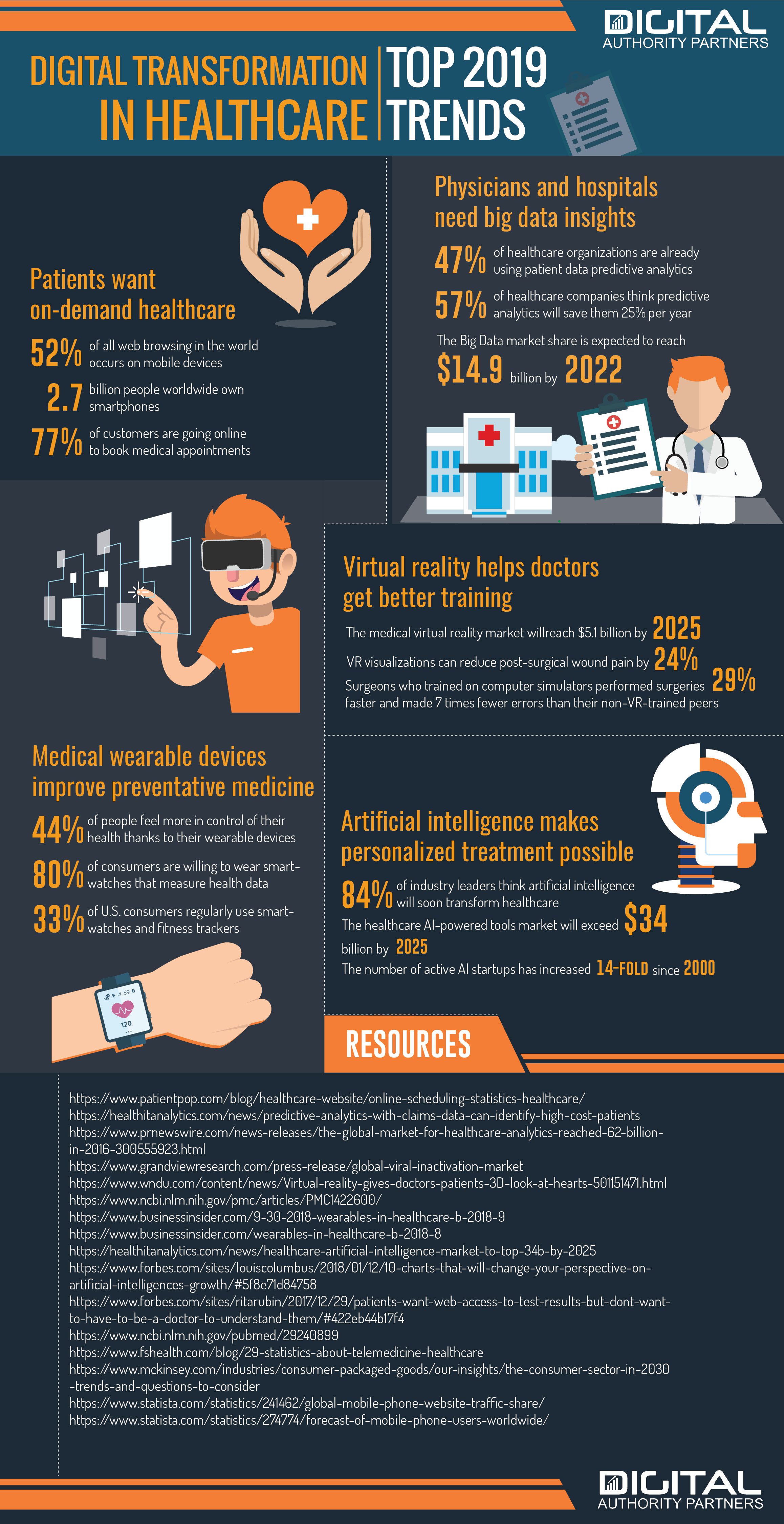
People have simply become far more than mobile in the past decade. Mobility is the proper noun of the game, and contempo statistics show that more than than 50% of all web browsing in the world occurs on mobile devices as of 2018 (to be verbal, 52%).
One of the showtime rules of content marketing is that you must identify where your targeted consumers gather and reach them on those platforms, i.east. mobile. That's not surprising given that 77 pct of U.S. residents own a smartphone . On top of that, the number of mobile phone users in the earth is expected to pass the 5 billion marking by 2019.
Gene in that more than 4 billion people globally are on the Cyberspace and you tin can outset to see the possibilities that digital transformation in healthcare offering.
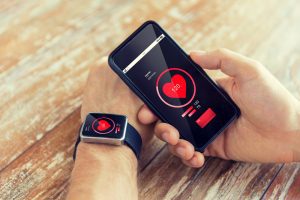
According to DMN3 , consumers are going online to obtain medical information for the following reasons:
- 47% enquiry doctors
- 38% research hospital and medical facilities
- 77% volume medical appointments
But on-demand healthcare is also driven past the growth of the 'gig' economy, in which freelance professionals in diverse industries hire themselves out per job or 'gig,' instead of tethering themselves to ane visitor.
Companies such equally Nomad Wellness – an online marketplace that links doctors directly with medical facilities for short-term work – are making it easier for physicians to provide on-demand healthcare to clients in specific circumstances that friction match their talents, expertise, and schedule. In other words, doctors themselves become on-demand healthcare providers to better meet the changing needs of their patients, another do good of digital transformation in the healthcare manufacture.
ii) The importance of big data in healthcare
Big information aggregates information nigh a business through formats such as social media, ecommerce, online transactions, and financial transactions, and identifies patterns and trends for future use.
For the healthcare industry, big data tin provide several important benefits , including:
- Lower rate of medication errors – through patient tape assay, software can flag any inconsistencies between a patient'southward health and drug prescriptions, alerting health professionals and patients when there is a potential risk of a medication mistake.
- Facilitating Preventive Care – a high volume of people stepping into emergency rooms are recurring patients likewise called "frequent flyers." They can account for up to 28% of visits . Large data assay could place these people and create preventive plans to go on them from returning.
- More Accurate Staffing – large data's predictive analysis could help hospitals and clinics guess future admission rates, which helps these facilities allocate the proper staff to bargain with patients. This saves money and reduces emergency room wait times when a facility is understaffed.
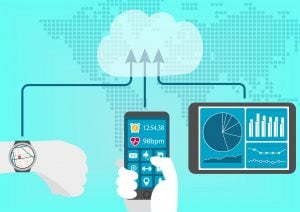
With these benefits in mind, healthcare and pharmaceutical companies should invest in organizing their data. That requires an investment in analytics experts who can crunch the information to not simply identify areas of weakness, only to also help companies meliorate understand their market.
For example, if you're in the pharmaceutical manufacture, yous probably sympathize that marketing dynamics are constantly shifting. In fact, drugmakers believe that the biggest advantage of large data is how it helps them empathise the market . And with that understanding, they tin determine product iteration and product budgets based on existing and future demand.
With a better grasp of the marketplace, your healthcare marketing and sales teams will have an easier time identifying your ideal consumer. And a big part of that is creating a customer persona , which compiles demographic information on what your prospects desire and need, and the platforms where you can attain them.
3) Treating patients with virtual reality
10 years agone, telling people you could reduce their pain with a device like to a video game would accept garnered a lot of blank stares. In 2018, notwithstanding, Virtual Reality (VR) is the pièce de résistance of digital transformation in healthcare. Its myriad of applications are profoundly changing the way patients are existence treated.
Take hurting management for instance. Upwardly until recently, doctors were handing out opioids prescriptions similar candy. Migraines? Postoperative hurting? Here's some OxyContin, Vicodin, or Percocet. As a upshot, the land is currently facing the worst drug crunch in American history, representing an economic brunt of $78.5 billion a yr .
Hither's the matter: millions of people are yet struggling with chronic pain. According to the CDC, fifty million of U.S. adults had chronic hurting in 2016. For them, VR is a safer, more than efficient alternative to drugs . VR applied science is beingness used not just to care for hurting, merely everything from feet to post-traumatic stress disorder, and stroke.
And that'southward just a fraction of VR's proven capabilities in the medical field. Other uses include, doctors and residents using virtual-reality simulations to hone their skills or to plan complicated surgeries. VR headsets could likewise motivate wearers to exercise and help children with autism learn how to navigate the world.
From startups to pharma giants, anybody is betting on VR and there are numbers to back them up. The global virtual and augmented reality in healthcare market is expected to achieve $5.one billion by 2025 . If you're a healthcare company planning your digital marketing strategy , yous should highly consider investing this technology.
VR is a powerful communication channel that would allow yous, among other things, to become a better sense of your customers' needs and virtually engage them with your products or services.
4) The growth of article of clothing medical devices
Another trend of the digital transformation in healthcare is companies collecting their ain health information from medical devices, including article of clothing engineering.
In the past, most patients were satisfied with undergoing a physical once a twelvemonth, and only checking in with their doctors when something went incorrect. Only in the digital age, patients are focusing on prevention and maintenance, and demanding information most their health more than ofttimes.
As a result, healthcare companies are being proactive by investing in wearable technology devices that tin provide up-to-engagement monitoring of high-risk patients to make up one's mind the likelihood of a major wellness issue. According to a contempo report, the wear medical device market is expected to reach more than $27 1000000 by 2023, a spectacular leap from almost $8 million in 2017.
Some of the well-nigh common of these devices include:
- Heart rate sensors
- Exercise trackers
- Sweat meters – used for diabetics to monitor blood sugar levels.
- Oximeters – monitors the amount of oxygen carried in the claret, and is often used by patients with respiratory illnesses such as COPD or asthma.
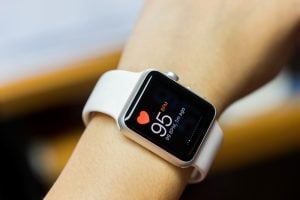
Other benefits for healthcare companies who invest in these products:
- Personalizes the healthcare experience – medical devices give patients a sense of ownership in the procedure of improving their health.
- Targets insurance pricing – information obtained from wearable devices tin help insurers more accurately rate a patient'southward take chances for affliction.
- Provides insurance incentives – patients who take preventive measures to better their health can obtain lower insurance premiums.
- Provides gamification opportunities – some medical devices such every bit fitness watches tin create competitive goals for users to accomplish through exercise, nutrition and nutrition.
Furthermore, wearable technology can also help healthcare companies salve money. One study found that health apps and wearables for preventative care could salvage the U.Due south. healthcare organisation close to $7 billion per yr.
v) Predictive healthcare
Earlier, we touched on how big data could provide healthcare companies with predictive assay near access rates and help them properly staff their facilities. Just some other factor supporting the digital transformation in healthcare is predicting what illnesses and diseases volition become major problems in the virtually time to come.
Data aggregated through Big Data and other marketing sources tin help healthcare companies develop healthy lifestyle recommendations for their patients.
For instance, yous could hire an analyst to analyze keyword action across social media channels and on major search engines to determine the about common searches for medical conditions , illnesses, and general health. The analyst could and then develop a predictive model that would conceptualize where and when the side by side large health scare volition occur, and how your visitor can prepare for that event.
Just on a smaller scale, predictive analysis could help businesses of all sizes make up one's mind when to hire temporary staff due to impending outbreaks of colds and influenza that could event in a worker shortage.
6) The wonders of artificial intelligence
Artificial intelligence (AI) is more than just a digital transformation trend in healthcare. AI represents the epitome of medical innovation and industry players are eager to invest millions in it. The healthcare AI-powered tools marketplace is expected to exceed $34 billion by 2025 , which ways this engineering science will shape almost all facets of the industry.
For most patients, AI in medicine brings to heed Japanese nurse robots. Just now, there are plenty of American versions as well, like Moxi , a friendly infirmary droid designed to assistance human nurses with routine tasks such every bit fetching and restocking supplies.
Chatbots and virtual health assistants are another AI-based engineering science that patients are becoming familiar with. Chatbots tin can fill a multitude of roles from customer service representatives to diagnostic tools and even therapists . Their versatility is being translated in heavy investments. The global healthcare chatbots market is projected to reach $314.3 million by 2023 from $122 meg in 2018.
Only the real power of AI can be best observed in areas like precision medicine , medical imaging, drug discovery, and genomics. For instance, cancer patients used to receive cookie-cutter treatments with high failure rates. At present, thank you to AI'due south sophisticated pattern recognition, these patients have admission to personalized therapies tailored to their genetic makeup and lifestyle.
What AI-powered computer programs do for oncology, in a nutshell, is analyze thousands of pathology images of various cancers to provide highly authentic diagnoses and predict the best possible anti-cancer drug combinations. And, in medical imaging diagnostics, this applied science helps radiologists spot details that escape the human eye.
What AI-powered computer programs do for oncology, in a nutshell, is clarify thousands of pathology images of various cancers to provide highly accurate diagnoses and predict the best possible anti-cancer drug combinations. Click To Tweet
What's more than, top pharmaceutical and biotechnology companies are using motorcar learning algorithms to shorten the drug development cycle. In fact, recent findings testify that AI can slash early on drug discovery timelines past four years confronting the industry average, and generate cost savings of 60 percent.
Overall, AI is predicted to bring $150 billion dollars in almanac savings for the United states of america healthcare economic system by 2026. Startups are already jumping on this opportunity; the number of active AI startups has increased 14-fold since 2000 .
These numbers alone should be plenty to convince whatever CEO looking to usher their health organization into reaching digital maturity that AI is worth the investment.
vii) Blockchain and the hope of amend electronic health records
Blockchain has recently developed a bad reputation due to the outburst of the cryptocurrency chimera . Now, the average person thinks of blockchain as of this vague, puzzling concept that doesn't have much of an touch on their life. In reality, this technology will shortly play an instrumental role in keeping their electronic health records authentic and safe.
Blockchain is a digital ledger or a computerized database of transactions. Shared across a network of computers, it allows customers to safely exchange financial information with suppliers, without the need of a third party such equally a banking company.
The healthcare and pharmaceutical industries are already vouching for its efficiency by investing millions in this market. According to a recent report, blockchain in healthcare marketplace is expected to reach $890.five million past 2023 .

In healthcare, blockchain is proven to exist an effective tool in preventing data breaches, improving the accuracy of medical records, and cutting costs.
For years, health officials and experts accept been trying to come upwardly with doable solutions to the trouble of fragmented medical records .
An electronic health record (EHR) is basically the digital version of a medical chart and includes everything from a patient'southward medical history and diagnoses, to treatment plans, immunization dates, and test results. It besides contains their dwelling address, previous workplaces, as well equally financial information like credit card numbers. This is what makes EHRs such an appealing target for hackers, who are selling them for upwardly to $one,000 on the black market.
Nonetheless, for as valuable as they are, hospitals are falling short in managing their EHRs.
Medical data is currently being recorded in unstructured formats and stretched beyond multiple EHR systems. Already short-staffed doctors and nurses struggle to manually log in every piece of data. This leads to huge errors such as duplicate medical records, misdiagnoses, delayed treatments, and even deaths.
Some countries like Australia and United kingdom of great britain and northern ireland have started to experiment with blockchain technology to manage medical records and transactions among patients, healthcare providers, and insurance companies. Thanks to a decentralised network of computers that handle the blockchain and simultaneously register every transaction, conflicting data is automatically detected. Records are non only 100% accurate, but also harder to hack.
I n the U.South., regulations brand it harder for companies to create blockchain-based EHRs. Some startups like Medicalchain , nonetheless, are making big strides towards a future where patients will control their EHRs from an app , where doctors, pharmacists, or wellness insurers will exist requesting permission to admission their information and where all transactions volition be recorded on the distributed ledger.
Health in the palm of your hand
The healthcare system is undergoing a seismic shift in how information is obtained and disseminated. Gone are the days when all medical information was under the lock and key of doctors and surgeons, and patients had to sign away their lives to access their own health data – consumers want to be able to access all aspects of their health record and do and then from the palm of their manus.
Through tools such as online patient portals that provide medical test results, diagnosis, and explanations of illnesses, patients are now condign participants in their well existence.
And that allows doctors to clarify patients in real-fourth dimension.
What does information technology really mean when your FitBit says you lot've completed 14,000 steps in a mean solar day? By itself, that is just information. Information technology becomes valuable when doctors and medical analysts transform that this data into actionable noesis about how those steps helped y'all fire a specific number of calories, and that increasing those steps will help you maintain your platonic weight. While digital applied science is a valuable tool in healthcare, information technology's of import to remember that it is still merely a tool that you tin can add in your repertoire.
5G mobile technology for instantaneous healthcare
Speaking of health in the palm of your health or in your pocket…As wireless technology gets more sophisticated, and so does the commitment of medicine.
Introduced by Qualcomm, the globe's largest mobile chipset supplier, 5G enhanced Mobile BroadBand (eMBB) is considered to be the commuter of the new mobile industry revolution.
The technology can run up to 100 times faster than the current cellular connection, which made industry experts confident that it will completely modify the healthcare landscape and pb to savings of up to $650 billion by 2025 .
Here's how.
Offset, Qualcomm says 5G will make "buffering" a affair of the past, allowing for instantaneous streaming, downloading, and uploading. For telemedicine, this ways patients volition feel meliorate video briefing quality, regardless of location. More importantly, doctors will take admission to authentic, existent-time imaging of organs, soft tissue, and bones, which in turn will profoundly decrease the adventure of misdiagnosis .
With the current network bandwidth, it takes hours for doctors to transport large imaging files to a specialist. Once health facilities will switch to 5G networks, the transmission procedure will take merely a couple of minutes.
And that's non even a fraction of how 5G could transform healthcare.
"5G is designed to pair with technologies like artificial intelligence and XR to heighten current services and applications, offering a unlike level of user experiences," says Qualcomm .
Allow'southward take a look at some practical examples:
- Clinicians could soon apply ultra-reliable connections to teleport to virtual environments and perform robotic surgeries.
- Augmented reality (AR) glasses would allow first responders to connect with faraway specialists and "show" them exactly what they are seeing, in club to receive better guidance.
- 5G could also back up medical preparation, enabling students to use virtual reality headsets to practise at their own stride the steps of complex surgeries.
- 5G-enabled drones could evangelize life-saving medicine or devices to patients in hard-to-reach rural areas. A university in Sweden is already testing these drones to evangelize defibrillators to cardiac arrest victims.
But it is in the wearable medical device market where 5G volition cause the greatest disruption. Remote monitoring technology has all the same to accomplish its full potential due deadening network speeds and unreliable connections. With 5G, clinicians will be able to instantaneously collect medical data such as a vitals or concrete activeness levels from disparate sources and large groups of patients and brand fast, reliable diagnoses .
This is preventative intendance at its best: fewer people developing chronic conditions and less coin spent caring for patients in hospitals or in emergency rooms. All in all, 5G is guaranteed to play a major role in healthcare this year and patients volition be the first ones to feel the positive changes. The outset 5G information cards were launched in 2019 forth 5G smartphones which besides striking the marketplace last yr .
The state of digital transformation in healthcare (both web and mobile) in 2022 looks quite promising, doesn't it?
Every bit with any business, the goal is to create products and services that meliorate lives or fulfill a desire or demand. Technology tin can assist yous realize this goal. Apply this guide as a compass to navigate your way through the digital healthcare space and to build transformative experiences – with the client at the center of everything you do.
Practice you need guidance with your digital transformation initiatives? Digital Authority Partners has worked with companies like Athenahealth, Omron Healthcare and Blue Cross Blue Shield on cutting-border digital initiatives that better patient outcomes and quality of care. Contact Digital Potency Partners at [email protected] or (312) 600-5433.
Y'all may also exist interested in reading our in-depth Healthcare industry reports:
- Blockchain in Healthcare: An Executive's Guide for 2020
- Artificial Intelligence in Healthcare: 27 Companies Leveraging AI to Amend Health Outcomes
- Artificial Intelligence & the Pharma Industry: What's Next
- Big Data in Healthcare: All You Demand to Know
- 5 Tips for Healthcare Website Design Initiatives in 2020
- The State of Digital Transformation in Healthcare in 2020
- ix Cardiovascular Wellness Technologies Doctors Should Know in 2020
- Alexa in Healthcare: 17 Real Utilize Cases Y'all Should Know About
- [Guide] 10 Digital Healthcare Analytics Every Provider & Payer Should Measure in 2020

Source: https://www.digitalauthority.me/resources/state-of-digital-transformation-healthcare/
Posted by: petersheirstles.blogspot.com
0 Response to "What Role Does Long-term Care Services Play In The U.s. Healthcare Delivery System?"
Post a Comment